는개 NeunGae
Oh Heewon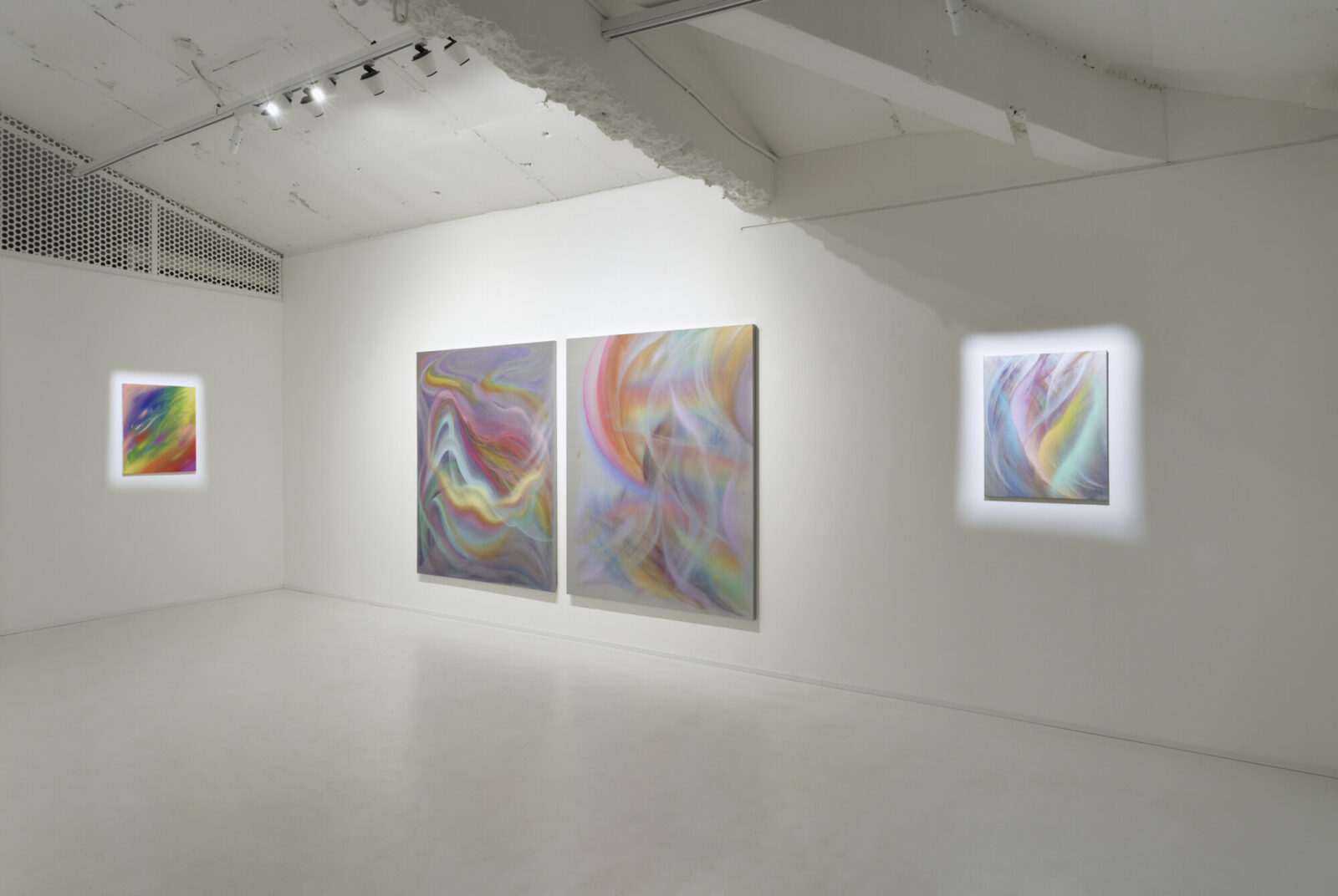
는개 NeunGae
2026.10.15-11.27
그림에 날씨가 생기는 동안
박가희(기획자)
은빛의 화면 위로 색이 번지고 흐른다. 어느 부분은 물이 고인 표면처럼 보이고, 어느 부분은 구름이나 빛이 번지는 하늘을 떠올리게 한다. 그러나 화면 앞에서 위치를 옮기면 방금 보았던 색은 희미해지고 다른 색이 떠오른다. 가까이 다가가면 풍경처럼 보였던 것은 다시 물감이 흐르고 겹치고 말라붙은 흔적으로 돌아간다. 이 화면에서 이미지는 어디에 있는 것일까. 캔버스 위에 이미 만들어져 있는 것일까, 아니면 물질과 빛, 그것을 바라보는 사람의 위치가 만나는 순간마다 나타나는 것일까.
이번 개인전의 제목인 ‘는개’는 안개비보다 조금 굵고 이슬비보다 가는 비의 상태를 가리킨다고 오희원 작가는 설명한다. 안개와 비 어느 한쪽으로 온전히 규정되지 않은 채 그 사이에 머무는 상태다. 작가는 이 단어에서 “어떤 하나의 상태로 규정되지 않고 그 사이에 머무는 감각”을 떠올린다.[1] 이 글은 바로 그 ‘사이’가 화면에서 어떻게 만들어지고 변화하는지를 따라가 보고자 한다. 비와 안개, 노을과 수면이 어떤 이미지로 그려지는가보다, 하나의 이미지가 물질과 빛, 시간과 움직임 속에서 어떻게 모습을 얻고 다시 달라지는가를 살펴보는 것이다.
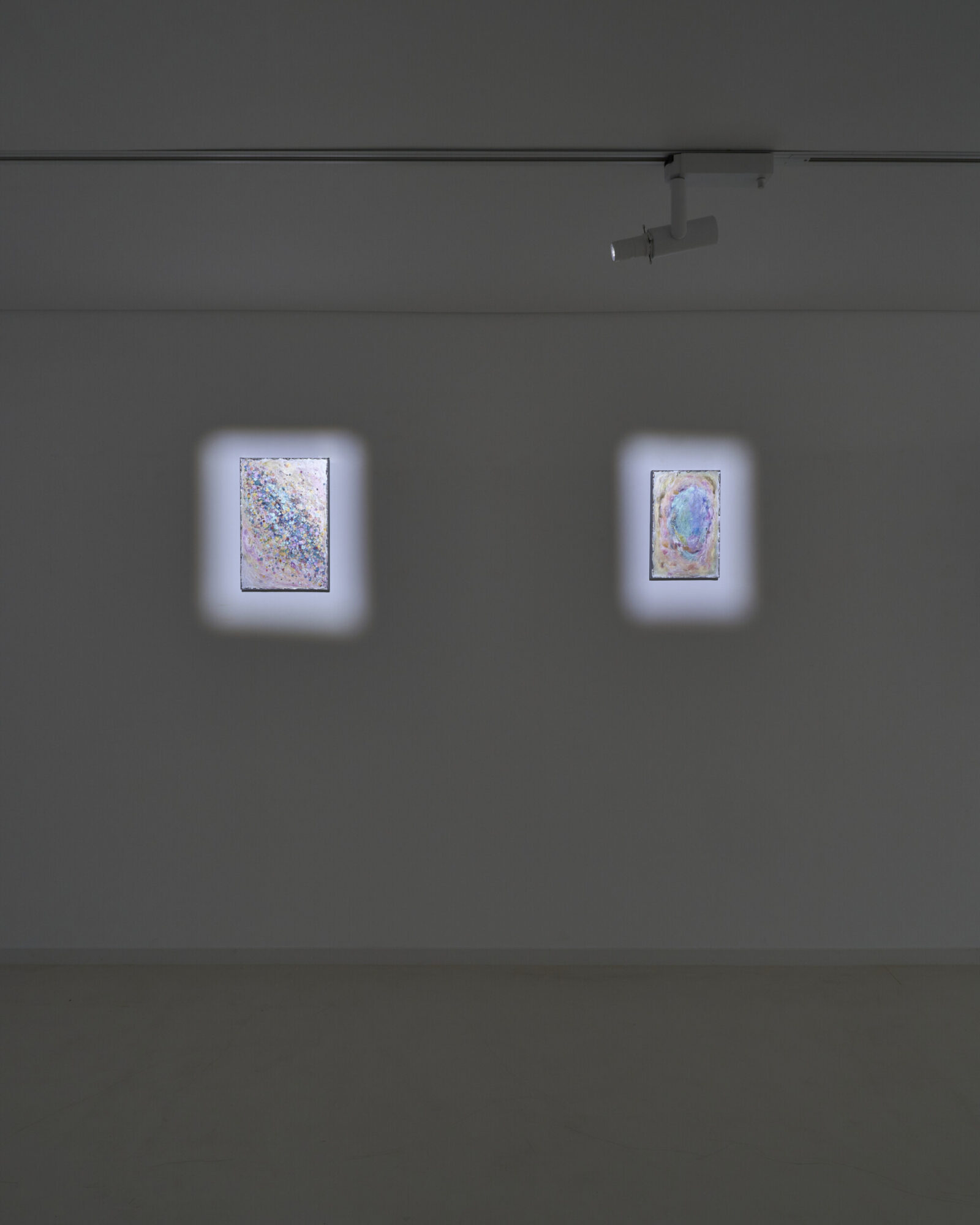
〈고요한 는개와 함께〉(2026)의 작은 화면은 앞선 질문을 압축해서 보여준다. 멀리서는 보랏빛과 청록빛, 옅은 분홍빛이 뒤섞인 흐린 대기나 젖은 풍경처럼 보이지만, 가까이에서는 반짝이는 입자와 물감이 겹치고 마른 표면이 먼저 눈에 들어온다. 아크릴과 이리데슨트 미디엄, 글라스 비드 젤, 모델링 페이스트가 포개진 화면에는 매끈한 부분과 거칠게 쌓인 부분이 공존한다. 특히 가장자리에는 물질이 불규칙하게 모여 가느다란 테두리를 만든다. 그것은 화면을 구획하기 위해 먼저 그어진 선이라기보다, 물감과 미디엄이 퍼지고 밀려가다가 캔버스의 끝을 만나 멈추며 생긴 흔적에 가깝다. 멀리서 하나의 이미지로 모이던 것이 가까이에서는 그것을 만들어낸 물질의 움직임으로 다시 흩어진다.
오희원의 회화가 그것이 놓인 환경과 관람자의 위치에 따라 달라진다는 점은 이번 전시에서 처음 등장한 것은 아니다. 2017년 개인전 《Parallel Grounds》에 전시된 그의 회화를 보며 윤원화 비평가는 “광학적이고 물리적인 실체”로 보면서도 그것이 “환경에 독립적으로 존재하는 것은 아니”라고 썼다.[2] 2021년 개인전 《rays Blooming》에서 시인이자 그래픽 디자이너인 김리윤 역시 은빛 화면 앞을 “오른쪽으로 두 걸음, 왼쪽으로 다시 한 걸음” 움직이며 어느 각도에서도 동일하게 주어지지 않는 밝기를 묘사한다.[3] 이전부터 오희원의 회화에서 빛과 공간, 관람자의 몸은 이미 화면이 보이는 방식에 개입해온 셈이다.
2020년경부터 이어진 색연필 작업에서도 이러한 출현과 소멸은 중요한 문제였다. 은빛 바탕 위에 가느다란 색연필 선을 반복해서 겹친 화면에서 선들은 반사광과 만나 관람자의 위치에 따라 선명해지거나 희미해지고, 때로는 화면에서 떠오른 듯한 부피감을 만든다. 작가는 이처럼 자신의 의도만으로 결정되지 않은 채 이미지가 “드러났다가 사라지는” 순간을 두고 “시적”이라고 표현한 적이 있다.[4] 여기에서 이미지는 언제나 동일한 모습으로 주어지는 것이 아니라 특정한 조건 속에서 출현하고 다시 물러난다.
다만 이번 작업에서 중요한 것은 이러한 문제가 단순히 지속되고 있다는 사실보다 그것이 다른 방식으로 발생하기 시작했다는 점이다. 오희원은 이전에도 색연필, 아크릴 등을 비롯한 여러 안료와 재료를 사용해왔다. 다만 이번 전시에서 보다 두드러지는 것은 물감과 미디엄의 유동성 자체가 이미지를 만들어가는 과정에 적극적으로 개입한다는 점이다. 작가의 설명에 따르면 이전에는 은빛 바탕과 그 위에 놓인 색연필 이미지의 관계가 비교적 분명했다면, 최근 페인팅에서는 그 관계가 흐려지고 때로는 뒤집힌다.[5] 물감은 이미 마련된 바탕 위에 형상을 얹는 데 그치지 않고, 흐르고 스며들고 서로 겹치거나 고이면서 화면의 상태 자체를 변화시킨다. 재료의 변화는 바탕 위에 이미지를 만드는 방식에서 바탕과 이미지가 함께 발생하는 방식으로 회화의 구조를 조금씩 이동시키고 있다.
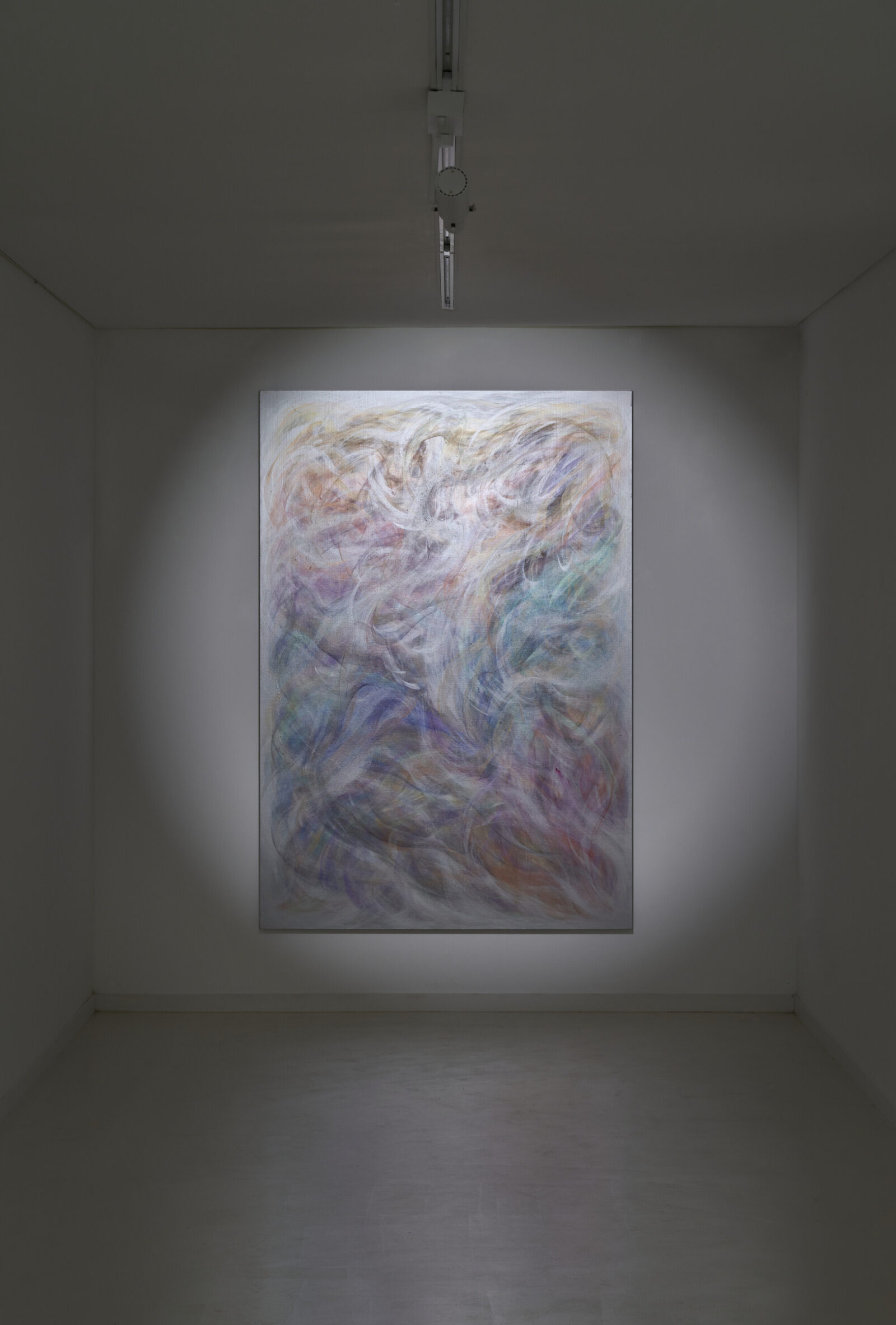
이 변화는 이번 전시에 놓인 크고 작은 화면에서 서로 다른 속도로 나타난다. 〈산란한 대기 틈새로〉(2026)에서는 희고 옅은 흐름 사이로 청록과 분홍, 주황의 색이 나타났다 사라지며 긴 화면을 가로지른다. 〈깨진 무지개가 하늘에 번져〉, 〈무지갯빛 구름을 만들고〉, 〈무게 없는 것들의 목적 없는 분기〉(이상 2026)에서도 색은 하나의 형태 안에 머물기보다 휘어지고 갈라지며 서로의 영역으로 스며든다. 반면 〈반짝임으로 꿴 옅은 어스름〉이나 〈붉은 노을에 잠긴 수면〉(이상 2026)과 같은 작은 화면에서는 물질의 두께와 요철이 더욱 또렷하게 드러난다. 이리데슨트 미디엄과 모델링 페이스트가 더해진 물감은 흐르는 동시에 고이고, 화면 안쪽뿐 아니라 가장자리에도 쌓인다. 한쪽에서 색이 산란하고 흐른다면 다른 쪽에서는 고이고 맺힌다.
흥미롭게도 화면 가장자리에 색이 모이는 현상 자체에는 이전 작업과의 연속성도 있다. 박지형 기획자는 2019–2020년경 제작된 〈이슬 그림자〉 연작에 대해 “모서리에 칠해진 각양각색의 색”이 창가 가장자리에 붙은 성에를 닮았다고 쓴 바 있다.[6] 다만 이번 작은 화면들에서 눈에 띄는 것은 가장자리가 이미지의 배치만으로 만들어지지 않는다는 점이다. 물감과 미디엄 자체가 이동하고 쌓이며 화면 끝에 불규칙한 두께를 만든다. 이전 작업에서 모서리가 색채가 자리 잡는 장소였다면, 이번에는 물질이 이동한 시간이 축적되는 장소가 된다. 화면의 경계가 그려지는 것이 아니라, 물질의 움직임 속에서 생겨나는 것이다.
이러한 차이는 작가의 제작 방식과도 연결된다. 오희원은 이번 작업에서 별도의 에스키스 없이 캔버스에 바로 물감을 올리고, 여러 화면을 동시에 펼쳐놓은 채 작업했다. 어떤 캔버스는 세워두고 어떤 것은 바닥에 눕혔다. 세워진 화면에서는 중력이 물감을 끌어내리고, 수평으로 놓인 화면에서는 물감이 고이고 퍼지며 다른 흔적을 만든다. 작가는 이 과정에서 “고정된 이미지를 만들지 말자”는 생각을 가지고 작업했다고 말한다.[7] 그러나 이는 화면을 우연에 내맡긴다는 뜻과는 다르다. 물감을 올리고, 그것이 움직이는 것을 지켜보고, 다시 개입하고, 기다렸다가 또 다른 결정을 내리는 과정이 반복된다. 작가가 결정하는 것과 재료가 만들어내는 것 사이의 왕복이 그림을 조금씩 다음 상태로 옮겨간다.
제임스 엘킨스(James Elkins)는 『What Painting Is』(1999)에서 회화를 미리 정해진 이미지를 물질 위에 실현하는 일로 설명하기보다, 화가가 물감의 물리적 성질을 다루면서 완전히 통제할 수 없는 변화와 씨름하는 과정으로 바라본다.[8] 그가 강조하는 것은 회화를 완성된 이미지의 차원에서만 바라볼 때 쉽게 사라지는, 물질과 화가 사이의 구체적인 접촉이다. 이러한 관점에서 오희원의 작업에서 흐름과 얼룩, 겹침과 침전 역시 특정한 화면을 구현하기 위한 수단이라기보다, 작업 과정에서 이루어진 판단과 반응의 흔적으로 읽힌다.
실제로 작가는 이번 작업을 진행하며 많이 “헤맸다”고 말한다. 일부 작품에 나타나는 감정의 요동 역시 이미 존재했던 개인적인 감정을 그림으로 옮긴 결과가 아니라, 그림이 무엇이 될지 알 수 없는 상태에서 작업을 지속하는 가운데 생겨난 동요에 가깝다고 설명했다.[9] 이 구분은 중요하다. 감정이 그림보다 먼저 존재하고 그림이 그것을 전달하는 것이 아니라, 그림을 만들어가는 과정 자체가 작가에게 어떤 상태를 발생시킨다. 그렇다면 이 그림을 만드는 것은 작가의 손만은 아니다. 물감의 점성과 양, 캔버스가 놓인 방향, 중력과 마르는 시간, 은빛 표면과 빛이 화면의 변화에 함께 개입한다. 〈산란한 대기 틈새로〉의 색과 흰 흐름은 구름이나 비를 구체적으로 묘사하지 않으면서도 공기의 움직임이 잠시 눈앞에 나타난 듯한 인상을 만든다. 반대로 〈붉은 노을에 잠긴 수면〉에서는 두껍게 고이고 굳어진 물질로부터 노을과 수면이라는 이미지가 뒤늦게 떠오른다. 하나는 흩어지고 다른 하나는 고이지만, 두 경우 모두 풍경은 먼저 주어진 대상으로서 화면에 옮겨졌다기보다 물질의 움직임 이후에 모습을 얻는다. 그림 속에 날씨가 나타나기 전에, 그림을 만드는 과정에서 이미 날씨와 닮은 일이 벌어지고 있는 셈이다.
오희원의 작업에서 ‘는개’는 비나 안개, 노을 같은 기상현상을 재현하는 것과는 거리가 있다. 작가는 최근 자신의 작업에 대해 이야기하며 한 해 한 해 날씨를 다르게 체감하게 되었다고 말하고, “날씨만큼 존재감이 드러나는 것이 있을까?”라고 묻는다. 나는 이 말을 특정한 자연의 이미지를 그린다는 의미보다, 하나의 상태가 수많은 조건의 작용 속에서 계속 변화한다는 문제와 연결해볼 수 있다.
팀 잉골드(Tim Ingold)는 「Landscape or Weather-World?」(2011)에서 세계를 이미 완성된 풍경의 표면으로 바라보는 대신, 빛과 바람, 비와 같은 대기의 운동 속에서 인간이 보고 움직이고 감각하는 ‘weather-world’를 제안한다. 그에게 날씨는 풍경 위에 부가되는 외부 조건이 아니라, 우리가 세계를 경험하는 바로 그 가운데에서 벌어지는 변화다.[10] 이 개념을 오희원의 회화에 그대로 대입할 필요는 없다. 다만 그것은 이번 그림에서 이미지가 하나의 완결된 대상으로 존재하기보다 여러 조건이 만나는 가운데 계속해서 나타난다는 점을 생각할 수 있는 하나의 단서를 제공한다.
그림이 완성된 뒤에도 이 변화는 끝나지 않는다. 은빛 표면은 전시장의 빛을 받아들이고 관람자가 화면 앞을 움직일 때마다 다르게 반사된다. 작가 역시 이번 전시 노트에서 은빛 캔버스의 색이 보는 각도와 빛의 방향에 따라 다르게 나타난다고 설명한다. 어떤 색은 강하게 떠올랐다가 희미해지고, 깊이처럼 보였던 부분은 다시 평평한 표면으로 돌아간다. 이때 하나의 이미지는 캔버스 안에 완결된 채 존재한다기보다 물질과 빛, 공간과 관람자의 위치가 만날 때마다 잠시 모습을 얻는다. 이 작업에서 날씨는 재현되는 대상이라기보다 회화가 작동하는 방식에 가까워진다.
그런 점에서 은빛 바탕을 사용하지 않은 〈거기에는 어떤 이름붙일 수 없는 것이〉(2026)는 이번 전시에서 하나의 예외를 만든다. 이 작품은 은빛 아크릴 바탕이 아닌 일반 캔버스 위에 아크릴과 오일스틱으로 제작되었다. 은빛 표면의 반사가 없음에도 녹색과 노랑, 파랑과 붉은색은 명확한 윤곽 안에 머무르지 않고 서로 겹치고 번진다. 은빛 바탕 없이도 이미지의 불확정성이 지속되는 셈이다. 다만 이를 곧바로 작가의 작업이 광학적 효과를 넘어 다른 회화적 문제로 이동하고 있음을 뜻하는지는 아직 단정하기 어렵다. 오히려 지금은 앞으로의 변화를 가늠하게 하는 하나의 징후로 남겨두는 편이 적절해 보인다.
전시는 작가가 말한 ‘사이’의 감각을 공간적으로도 이어간다. 1층에서는 무지갯빛이 응축된 구덩이로 시작해 산란하는 대기와 노을이 잠긴 수면을 지나 고요히 내려앉는 는개로 향하고, 2층에서는 다시 일렁이며 상승하는 흐름으로 구성된다. 작품의 제목들 역시 앞선 문장이 다음 문장으로 흘러가듯 이어진다. 그러나 여기에서 ‘사이’란 두 개의 확정된 상태 사이에 마련된 안정적인 중간지대라기보다, 상태 자체가 계속 달라지고 있는 시간에 가까워 보인다. 산란하던 색은 고이고, 고인 물질은 화면 끝에서 굳어 경계를 만들며, 은빛 표면은 빛과 몸의 움직임에 따라 다시 다른 색을 드러낸다. 하늘과 수면, 구름과 비처럼 보였던 이미지는 잠시 모습을 얻었다가 다시 물감과 빛의 상태로 돌아온다.
그런 의미에서 《는개》라는 제목은 이 그림들이 무엇을 보여주는지를 확정하는 이름이라기보다, 아직 하나의 모습으로 결정되지 않은 것에 잠시 붙여둔 이름처럼 읽힌다. 작가는 완성될 이미지를 먼저 결정하지 않은 채 물질이 만들어내는 변화에 응답하고, 관객은 그렇게 만들어진 화면 앞을 움직이며 또 다른 변화를 만난다. 흐르고, 흩어지고, 고이고, 맺히고, 다시 모습을 바꾸는 동안 이 그림들은 날씨를 그리는 대신 조금씩 날씨와 닮은 방식으로 존재한다.
[1] 오희원, 작가 노트, 2026.9.
[2] 윤원화, 「어떤 풍경의 화가」, 2017. 오희원 개인전 《Parallel Grounds》(Chapter II, 서울, 2017).
[3] 김리윤, 「불투명한 빛을 투명하게 걸어두기」, 2021. 오희원 개인전 《rays Blooming》 도록, OL PRESS, 2021.
[4] 오희원과의 1차 미팅, 2026.7.
[5] 같은 미팅. 작가는 이전 색연필 작업에서는 “은분과 색연필의 관계가 분명히 보이고, 배경과 주인공으로 정리되어 있다면, 페인팅에는 그 관계가 전복되고, 없어진다”고 설명했다.
[6] 박지형, 「반짝이는 메아리들」, 2024.
[7] 같은 미팅. 2026.7.
[8] 제임스 엘킨스, What Painting Is: How to Think about Oil Painting, Using the Language of Alchemy, 2nd ed. (New York and London: Routledge, 2019). 엘킨스는 전통적인 미술사적 언어만으로 회화를 설명하기보다 스튜디오에서 물감을 섞고 다루는 물질적 경험, 특히 통제하기 어려운 물질과 화가 사이의 관계에 주목한다.
[9] 오희원과의 1차 미팅, 2026.7.
[10] 팀 잉골드, “Landscape or Weather-World?,” in Being Alive: Essays on Movement, Knowledge and Description (London and New York: Routledge, 2011), pp. 126–135. 이 글에서 잉골드는 풍경을 고정된 시각적 대상으로 파악하는 관점에서 벗어나 빛, 바람, 비 등의 대기적 운동 속에서 지각과 행위가 이루어지는 ‘weather-world’를 논한다.
While Weather Takes Shape in the Painting
Gahee Park (Curator)
Color spreads and flows across the silver surface. In places it looks like standing water; in others it calls to mind a sky where clouds or light have bled together. Yet when you shift your position before the canvas, the color you were just looking
at grows faint and another rises in its place. Step closer, and what looked like a landscape returns to being traces of paint that flowed, overlapped, and dried. Where, in these paintings, is the image? Is it already made on the canvas—or does it appear
each time matter, light, and the position of the person looking come together?
The title of this solo exhibition, NeunGae (neun-gae in Korean), refers, as Heewon Oh
explains, to a type of rain slightly heavier than a misting rain (angaebi) and finer than a drizzle (isulbi)—a state that cannot be fully defined as either fog or rain, and that dwells somewhere between the two. From this word the artist recalls
“a sense of dwelling in between, not defined as any single state.”[1] This essay sets out to follow how that “between” is made and how it changes on the canvas. The question is less what kind of image—rain and fog, sunset and water surface—is
being painted than how a single image takes shape, and takes on a different form again, within matter and light, time and movement.
The small canvas of <With the Still NeunGae> (2026) brings this question into focus. From a distance it looks like a hazy atmosphere, or a wet landscape, in which violet, blue-green, and pale pink are mingled; up close, what first catches the eye is a glittering of particles and a dried, layered surface of paint. On this canvas, where acrylic, iridescent medium, glass bead gel, and modeling paste lie over one another, smooth areas coexist with roughly built-up ones. Along the edges in particular, matter gathers irregularly into a thin rim. It resembles less a line drawn first to demarcate the picture than a trace left as paint and medium spread and were pushed along until they met the edge of the canvas and stopped. What gathered into a single image from afar disperses again, up close, into the movement of
the matter that made it.
That Heewon Oh’s paintings change according to their environment and the viewer’s position did not first emerge in this exhibition. Looking at her paintings shown in the 2017 solo exhibition《Parallel Grounds》, the critic Wonhwa Yoon wrote that they are “a physical and optical substance,” yet “do not independently exist separate from their circumstance.”[2] In the 2021 solo exhibition 《rays Blooming》, the poet and graphic designer Liyoun Kim likewise describes standing before a silver surface: “Two steps to the right, a step to the left. A brightness that refuses to distribute evenly over the picture no matter which angle one observes it from.”[3] In Oh’s paintings, then, light, space, and the viewer’s body have long intervened in how the picture is seen.
This emergence and disappearance was also a central concern in the colored-pencil works she has made since around 2020. In these works, fine colored-pencil lines are layered repeatedly over a silver ground; the lines meet reflected light and grow sharper or fainter depending on where the viewer stands, at times producing a sense of volume that seems to float up from the surface. The artist has called the moment when an image “appears and then disappears,” not determined by her intention alone, “poetic.”[4] Here an image is not always given in the same form; it emerges under particular conditions and recedes again.
What matters in the present work, however, is less the fact that this concern continues than that it has begun to arise in a different way. Oh has long used a range of pigments and materials, including colored pencil and acrylic. What stands out more in this exhibition is that the fluidity of the paint and medium themselves plays an active role in making the image. According to the artist, whereas the relationship between the silver ground and the colored-pencil image placed on it used to be
relatively distinct, in her recent paintings that relationship blurs and at times inverts. [5] Paint no longer merely places a form on a prepared ground; it flows, seeps in, overlaps, and pools, altering the state of the surface itself. The change in materials
is gradually shifting the structure of the painting from a way of making an image on a ground toward one in which ground and image arise together.
This change appears at different speeds across the large and small canvases in the exhibition. In <Through the Gaps in Diffused Air> (2026), blue-green, pink, and orange appear and vanish among pale white currents as they cross the long canvas. In <The Broken Rainbow Bled Across the Sky>, <Blooming into Iridescent Clouds>, and <The Aimless Divergence of Weightless Things> (all 2026) as well, color does not stay within a single form but bends and splits, seeping into one another’s territory. By contrast, in small canvases such as <Twilight Threaded with Shimmer> and <The Sunset Sank into the Water> (both 2026), the thickness and unevenness of the matter come through more distinctly. Paint to which iridescent medium and modeling paste have been added flows and pools at once, and builds up not only within the picture but along its edges. Where color scatters and flows on one side, it gathers and beads on another.
Interestingly, this very phenomenon of color gathering at the edge of the picture has a continuity with earlier work. The curator Jihyung Park once wrote of the <Dew Shadow> series (c.2019–2020) that the “variously colored hues painted at the corners” resembled frost clinging to the edge of a windowpane.[6] What stands out in
these small canvases, though, is that the edge is not produced by the arrangement of the image alone. The paint and medium themselves move and accumulate, creating an irregular thickness at the picture’s end. Where the corner in earlier work was a place for color to settle, here it becomes a place where the time of the material’s movement accumulates. The boundary of the picture is not drawn; it arises within the movement of matter.
This difference is also tied to the artist’s way of working. For this body of work, Oh put paint directly onto the canvas without preparatory sketches, and worked with several canvases laid out at once. Some canvases were stood upright; others were laid flat on the floor. On an upright canvas gravity pulls the paint down; on a
horizontal one the paint pools and spreads, leaving different traces. Throughout, she says, she worked with the thought “let’s not make a fixed image.”[7] But this does not mean leaving the picture to chance. A process repeats: paint is laid down, she
watches it move, intervenes again, waits, and makes yet another decision. The back-and-forth between what the artist decides and what the material produces carries the painting, little by little, into its next state.
In 『What Painting Is』 (1999), James Elkins approaches painting not as the realization of a predetermined image upon matter, but as a process in which the painter, working with the physical properties of paint, wrestles with changes that
cannot be fully controlled.[8] What he emphasizes is the concrete contact between matter and painter, which is easily lost when painting is regarded only
at the level of a finished image. Seen from this perspective, the flows and stains, overlappings and sedimentations in Oh’s work are read less as means to realize a particular picture than as traces of judgments and reactions made in the course of working.
Indeed, the artist says she “wandered” a great deal while making this work. The emotional turbulence visible in some of the pieces, she explained, is likewise not the result of transposing pre-existing personal feelings into paint, but closer to an
agitation that arose while she carried on working without knowing what the painting would become.[9] The distinction is important. It is not that emotion exists before the painting and the painting conveys it; rather, the process of making the painting itself
produces a certain state in the artist. If so, it is not only the artist’s hand that makes the painting. The viscosity and amount of the paint, the direction in which the canvas lies, gravity and drying time, the silver surface and light—all intervene together in the picture’s changes. The colors and white currents of <Through the Gaps in Diffused Air> create the impression of air in motion momentarily appearing before our eyes,
without depicting clouds or rain in any concrete way. Conversely, in <The Sunset Sank into the Water>, the images of sunset and water surface rise belatedly out of thickly pooled and hardened matter. One disperses and the other pools, yet in
both cases the landscape takes shape after the movement of matter, rather than having been transferred onto the canvas as an object given in advance. Before weather appears in the painting, something like weather is already taking place in
the process of making it.
In Oh’s work, NeunGae is far removed from the representation of meteorological phenomena such as rain, fog, or sunset. Speaking recently about her work, the artist says that she has come to experience the weather differently from year to year, and asks, “Is there anything that makes its presence felt as much as the weather?” I would
connect this remark less to the depiction of a particular image of nature than to the question of a single state continually changing under the influence of countless conditions.
In 「Landscape or Weather-World?」(2011), Tim Ingold proposes, in place of viewing the world as the surface of an already completed landscape, the ‘weather-world’, in which humans see, move, and sense within the movements of the atmosphere—
light, wind, rain.[10] For him, weather is not an external condition added onto a landscape but a change that takes place at the very center of our experience of the world. There is no need to apply this concept directly to Oh’s paintings. But it
offers a clue for thinking about how, in these paintings, the image does not exist as a single completed object but continues to appear where many conditions meet.
The change does not end once the painting is finished. The silver surface takes in the light of the exhibition space and reflects differently each time the viewer moves before it. The artist, too, explains in her note for this exhibition that the colors of the silver canvas appear differently depending on the viewing angle and the direction
of the light. A color rises strongly and then fades; what seemed like depth returns to a flat surface. At such moments an image does not exist complete within the canvas but takes shape momentarily each time matter, light, space, and the viewer’s position meet. In this work, weather comes closer to the way painting operates than to
something that is represented.
In that respect, <There’s Something About the Unnameable> (2026), which does not use a silver ground, makes an exception in this exhibition. It was made with acrylic and oil stick on an ordinary canvas rather than on a silver acrylic ground. Even
without the reflection of a silver surface, green and yellow, blue and red do not stay within clear contours but overlap and bleed into one another.
The indeterminacy of the image persists even without the silver ground. Still, it is hard to say definitively whether this means her work is moving beyond optical effects toward another painterly problem. For now, it seems more fitting to leave it as a sign that hints at changes to come.
The exhibition extends the sense of the ‘between’ of which the artist speaks into space as well. The first floor begins with a pit in which iridescent light is condensed, passes through scattering air and a water surface submerged in sunset, and
heads toward a quietly settling NeunGae; the second floor is composed of a flow that undulates and rises again. The titles, too, are linked as one sentence flows into the next. Yet the ‘between’ here seems closer to a time in which a state itself
keeps changing than to a stable middle ground set between two fixed states. Scattering color pools; pooled matter hardens at the edge of the picture to form a boundary; the silver surface reveals yet other colors as light and body move. Images that looked like sky and water, cloud and rain take shape for a moment, then return to the state of paint and light.
In that sense, the title 《NeunGae》 reads less as a name that fixes what these paintings show than as a name briefly attached to something not yet settled into a single form. The artist responds to the changes that matter produces, without deciding beforehand on an image to be completed, and viewers move before the surfaces so made and meet further changes. As they flow, scatter, pool, bead, and change form again, these paintings do not paint the weather; they exist, little by little, in a manner akin to weather.
[1] Heewon Oh, Artist’s Note, September 2026.
[2] Wonhwa Yoon, 「Painter of a Certain Landscape」, 2017. Heewon Oh solo exhibition 《Parallel Grounds》 (Chapter II, Seoul, 2017)
[3] Liyoun Kim, 「Opaque Light, Transparent Canvas」, 2021 (English translation by Emily Yae Won).
《rays Blooming》 exhibition catalogue, OL PRESS, 2021.
[4] First meeting with Heewon Oh, July 2026.
[5]Same meeting. The artist explained that in the earlier colored-pencil works, “the relationship between the silver pigment and the colored pencil is clearly visible, arranged as background and protagonist, whereas in the paintings that relationship is overturned and disappears.
[6] Jihyung Park, 「Glittering Echoes」, 2024
[7] Same meeting, July 2026.
[8] James Elkins, What Painting Is: How to Think about Oil Painting, Using the Language of Alchemy, 2nd ed. (New York and London: Routledge, 2019). Rather than explaining painting through the conventional language of art history alone, Elkins focuses on the material experience of mixing and handling paint in the studio, and in particular on the relationship between the painter and a material that is hard to control.
[9] First meeting with Heewon Oh, July 2026.
[10] Tim Ingold, “Landscape or Weather-World?,” in Being Alive: Essays on Movement, Knowledge and Description (London and New York: Routledge, 2011), pp. 126–135. In this essay Ingold moves away from the view of landscape as a fixed visual object and discusses the ‘weather-world’, in which perception and action take place within atmospheric movements such as light, wind, and rain.


